


OpenClaw is everywhere right now. If you follow AI socials, you’ve seen it trending hard: a local-first AI assistant that routes your LLMs through WhatsApp, Telegram, Slack, whatever channel you already live in. Meanwhile, WordPress continues to quietly power 43% of the web.
These two worlds haven’t met. Not properly anyway.
You can ask Claude or ChatGPT about your WordPress site, and it will respond confidently with generic advice that could apply to any site, anywhere. It genuinely has zero context about your world. No traffic data, no conversion metrics, no audience segments. It’s operating on vibes, and the results are predictably off the mark.
An interface without actionable intelligence, until now…
AI without context is just guessing
WordPress 6.9 shipped the Abilities API, which lets plugins declare what they can do in a format AI agents actually understand. It’s not designed for humans, but machine-readable capabilities with schemas, permissions, and execution logic. I dive into this in our recent report, WordPress in 2026. Our plugin Accelerate uses this to expose your site’s analytics, A/B tests, personalisation rules, and content performance as a structured MCP endpoint.
OpenClaw solved the reach problem. Accelerate solves the knowledge problem. And the difference between the two is bigger than it sounds: an AI that reads your site from the outside (scraping, guessing, summarising your homepage), versus one that lives inside it.
That’s twenty years of content, permissions, and business logic sitting in WordPress, now accessible to an agent that can actually reason about it. Your site knew what was wrong all along. It just couldn’t tell anyone until now.
The stack is straightforward:
- Conversation layer: OpenClaw
- Reasoning layer: Claude or Codex
- Ground truth layer: WordPress via Accelerate
What happened when we tried it
So I tested it on one of the sites I manage… Dog Help Kharkiv is a small animal rescue running WordPress out of eastern Ukraine, with a few hundred daily visitors. We connected OpenClaw via Accelerate’s MCP and asked a simple question: what’s this site getting wrong?
The answer was uncomfortably specific. Zero conversion tracking on the donate buttons, meaning we had no idea whether the most important button on the site worked..
- 20% of traffic comes from Ukraine, yet the site speaks exclusively to English-speaking donors.
- 68% of traffic arriving from ad networks, landing on a homepage hero that could instead have referral context.
- And the list goes on.
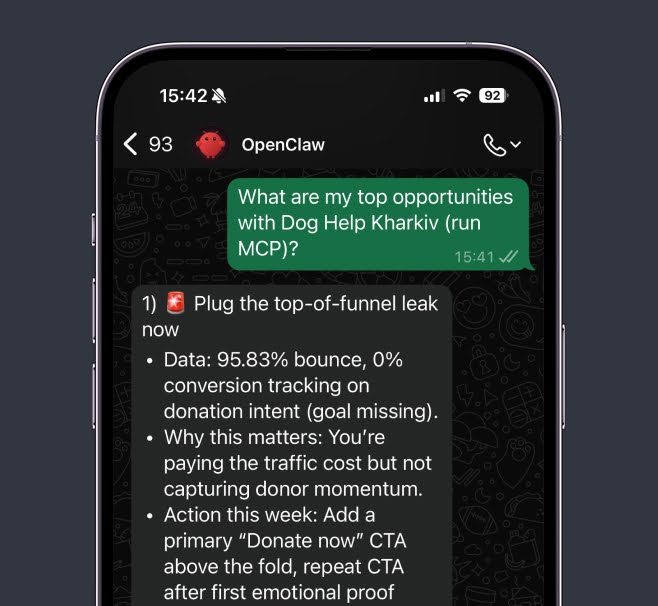
OpenClaw didn’t just flag these issues, it prioritised them. Enable conversion tracking on donation CTAs: 2 minutes. Test a stronger homepage headline: 5 minutes. Build audience personalisation for Ukrainian visitors: 10 minutes. Specific actions, all grounded in live site data. We’re almost at a point where typing the prompt takes longer than acting on the hyper-specific response.
This is not content generation
Last year AI wrote content.
This year AI audits operations.
Next year it executes.
At enterprise scale, this stops being about button tracking and starts being about governance, permissions, compliance, and operational oversight. WordPress already contains those rules: the Abilities API makes them accessible to agents.
This part of the WordPress + AI conversation is the momentous structural shift. Everyone has been focused on AI creating content for WordPress, but those are just table stakes now. The real unlock is AI reading your site, understanding your traffic patterns, your missed conversions, your audience blind spots; all the things your analytics dashboard was waiting for you to ask about (but you never did, because you didn’t know to ask).
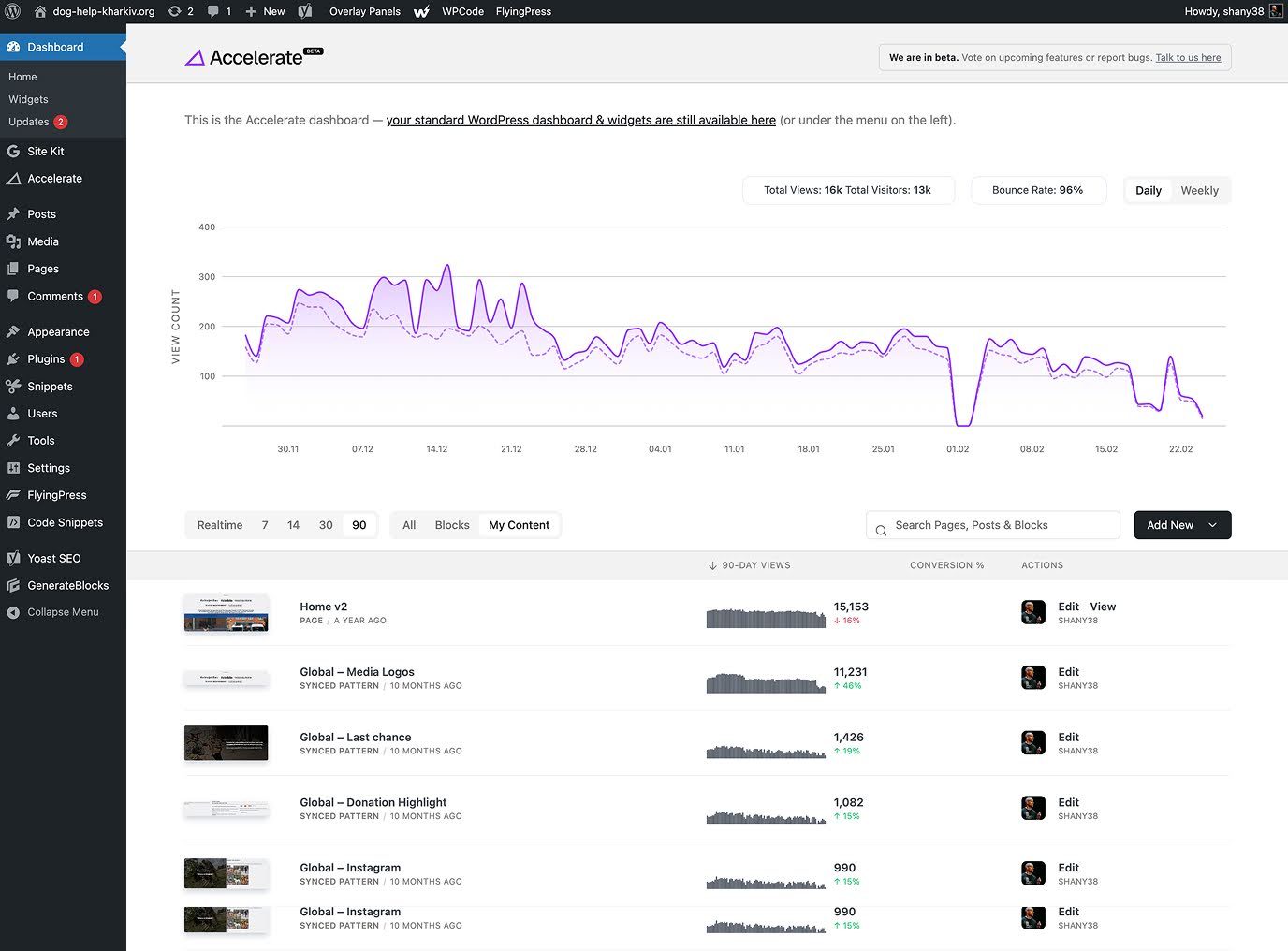
Let’s see what happens to my stats when I take on all of OpenClaw’s advice…
This is already shipping
The infrastructure for this isn’t theoretical. The Abilities API shipped in 6.9, the MCP adapter connects external agents today, and a native AI client is proposed for 7.0.
WordPress is becoming the ground truth that AI platforms need. That’s a calmer claim and a more durable ecosystem play than any proprietary solution will ever offer.