


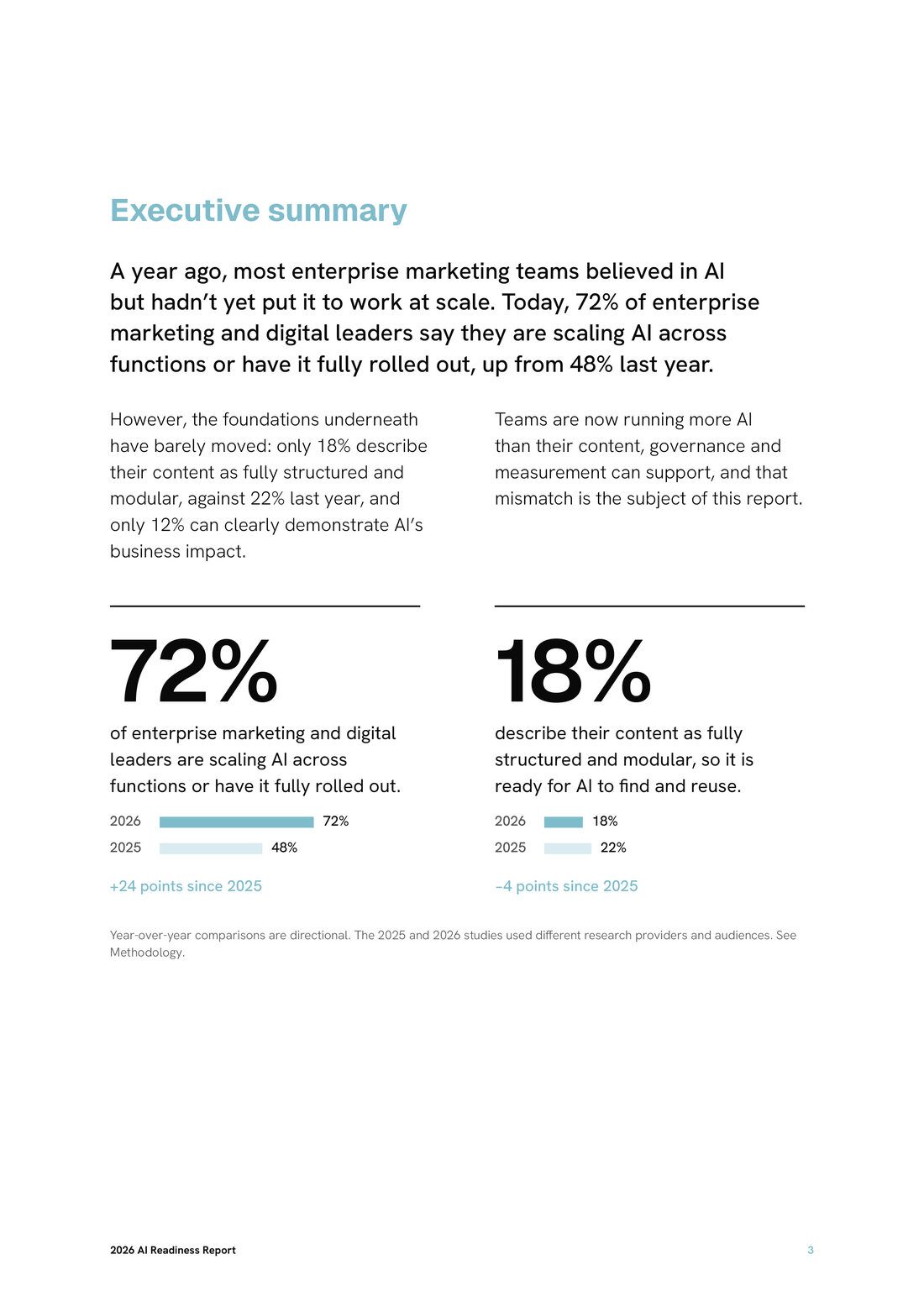
Most enterprise marketing teams now run AI in production. In October 2026, Human Made and WordPress VIP surveyed 100 enterprise marketing and digital leaders for the 2026 AI Readiness Report. 72% said they are scaling AI across functions or have it fully rolled out, up from 48% a year earlier. However, only 12% can clearly demonstrate its business impact.
AI Readiness Report 2026
72% run AI at scale. 12% can show its impact.
Scaling AI across functions or fully rolled out
Can clearly demonstrate its business impact
Source: The 2026 AI Readiness Report, Human Made and WordPress VIP. 100 enterprise marketing and digital leaders, October 2026.
The teams that can show results have more in common with each other than with everyone else. Specifically, they have structured content, a CMS that connects to new tools, clear AI policies, standardised workflows and measurement tied to business outcomes. In other words, very little of what sets them apart comes down to which AI tools they chose.
Who counts as furthest ahead?
To answer that, the report tracks three overlapping groups. First, 21% of respondents have AI fully rolled out. Second, 31% have strong foundations, meaning they agree both that their content is ready for AI and that their CMS can support new AI tools. Finally, 18% score as ‘Optimised’ on the report’s five-dimension readiness benchmark.
| Measure | Furthest ahead | Comparison group |
|---|---|---|
| Fully structured content | 43% (fully rolled out) | 14% (scaling) |
| Can clearly demonstrate AI’s impact | 33% (fully rolled out) | 10% (scaling) |
| Can clearly demonstrate AI’s impact | 23% (strong foundations) | 3% (weak foundations) |
| AI standardised or continuously optimised | 32% (strong foundations) | 11% (weak foundations) |
| Clear AI policies | 81% (strong foundations) | 51% (weak foundations) |
Their content is structured enough for AI to reuse
43% of teams with AI fully rolled out describe their content as fully structured and modular, against 14% of teams still scaling. Across the whole market, by comparison, the figure is 18%, and two-thirds of teams describe their content as partially structured. That share hasn’t moved in a year, even though AI adoption rose 24 points over the same period.
Content architecture
Who describes their content as fully structured and modular
Source: The 2026 AI Readiness Report, Human Made and WordPress VIP. 100 enterprise marketing and digital leaders, October 2026.
The reason this matters is practical. An AI tool or agent can only reuse content it can find and interpret. For example, if a product description lives inside a page layout, someone has to pull it out and clean it up before AI can work with it, every time. Teams that model their most-used content types properly (product, campaign, editorial) do that work once, so every tool they add afterwards benefits from it.
Their CMS takes on new tools without a custom project
Platform flexibility is the lowest-scoring dimension in the benchmark. 46% agree their CMS and content stack can readily support new AI tools, and a quarter disagree. Yet only 15% name their CMS as a barrier.
That gap exists because platform problems rarely show up under that name. Instead, they appear as an integration that runs three months over, or a tool that can’t find the right content. We’ve looked at this pattern in more detail in why AI is exposing weaknesses in enterprise platforms. In contrast, an API-first or headless CMS lets a team add a new AI tool, test it and drop it later without replatforming. A useful test for your own stack, then: could you add a new AI tool this quarter without a custom integration project?
Their AI policies make it easier to say yes
81% of teams with strong foundations have clear, consistently applied AI policies, compared with 51% of teams with weak foundations. Policy also tracks adoption closely: 87% of teams with clear policies are scaling AI or have it fully rolled out, against 50% of other teams.
Governance and control
Clear policies go with wider adoption
Scaling AI or fully rolled out
Source: The 2026 AI Readiness Report, Human Made and WordPress VIP. 100 enterprise marketing and digital leaders, October 2026.
Meanwhile, security and compliance is the most-cited barrier, named by 52% of respondents. A short policy that lists approved tools, what AI can do without review, what always needs a human and who signs off turns that concern into rules teams can work within. Because the tools change so quickly, the leading teams also review that policy every quarter.
They’ve standardised the workflows that already work
32% of teams with strong foundations have standardised AI across major processes or optimise it continuously, against 11% of teams with weak foundations. At the other end, 62% of the weak-foundation group still use AI ad hoc or in a few teams.
In practice, most organisations stall between “several repeatable workflows” and “standardised across major processes”. What closes that gap is an operating model: a named owner for each workflow, a shared playbook, one review step and training before rollout. Training is often the missing piece. As one respondent put it: “We have all been encouraged to adopt and harness AI but without the training.”
They measure outcomes as well as hours saved
61% of respondents name faster production as a top gain from AI. Far fewer, however, report gains in personalisation (13%) or reach (7%). At the same time, teams with AI fully rolled out are more than three times as likely to clearly demonstrate impact (33% vs 10%).
Measurement relies on the same foundations as everything above, because content has to be structured enough to track and systems connected enough to report on. Otherwise, the results are hard to add up. One marketing leader described the problem directly: “Right now each tool runs on its own, so it’s hard to show what the time savings are actually worth.”
They’re planning for agents with the groundwork in place
Looking ahead, 62% of teams with AI fully rolled out plan to prioritise agentic workflows in the next 12 months. Across the market, 44% plan to do the same. However, 80% of those teams don’t yet have fully structured content. Since agents act on content directly, the teams furthest ahead are starting agentic work with the inputs already in shape.
What the data can and can’t tell us
The comparison groups are small subsets of a 100-person sample. The differences are statistically significant; still, they show association rather than cause, and well-run organisations probably invest in foundations and measurement at the same time. All answers are also respondents’ own assessments. Even so, the pattern is consistent enough to act on, as long as the exact figures are read as indicative.
Where does your organisation sit?
The report scores enterprise AI readiness on five statements, one for each of the five pillars of AI readiness introduced in last year’s research. Together they give a total out of 25, and the average this year was 17. Generally, your lowest-scoring dimension is the one holding back the rest.
AI Readiness Report 2026
Download the 2026 AI Readiness Report for the full benchmark, the maturity matrix and a two-minute self-score worksheet you can run with your team.

FAQ: Enterprise AI Readiness
Enterprise AI readiness describes whether an organisation can use AI well across its operations, beyond individual productivity gains. The 2026 AI Readiness Report from Human Made and WordPress VIP measures it across five dimensions: strategic alignment, operational capability, governance and control, content architecture, and platform flexibility.
AI-ready content is stored as structured, modular parts with consistent tagging and metadata. As a result, AI tools and agents can find, reuse and cite it without a person preparing it first. Only 18% of enterprise marketing teams describe their content as fully structured and modular, according to The 2026 AI Readiness Report.
Most teams stall when moving from a few repeatable workflows to processes standardised across the organisation. The 2026 AI Readiness Report found that only 19% of teams have reached that stage. Usually the gaps are organisational: no named owner for each workflow, no shared playbook, and training that arrives after rollout or not at all.
Start with your two or three most-used AI workflows. For each one, write down the business outcome it should move as well as the time it saves. Then check whether your analytics can see that outcome today. Currently, only 12% of enterprise teams can measure AI’s impact very effectively with clear metrics.
A workable AI policy covers which tools are approved, what AI can do without review, what always needs a human, and who signs off. It should also be short enough that teams actually read it. Because AI tools change quickly, our 2026 AI Readiness Report recommends reviewing the policy every quarter.
Check three things before scoping an agentic project. Is the content the agent will act on structured and tagged? Is there a policy for what it can publish without review? Can you measure what it changed? For context, of the 44% of teams planning agentic workflows, 80% don’t yet have fully structured content.
Most enterprise marketing teams (71%) sit in the middle two levels of the AI Readiness maturity matrix, Developing and Established. By comparison, 18% have reached Optimised, the highest level. The average combined readiness score in the 2026 research was 17 out of 25.