



Critical thinking in agencies means questioning assumptions. It means weighing evidence. It means reasoning through a decision before committing to it, rather than accepting the first plausible-sounding answer just because it arrived quickly. And it matters more now than it did five years ago. Templates, automation, and AI-generated drafts increasingly shape the daily judgement calls an agency makes. It has never been easier to mistake a fluent answer for a correct one.
This article sets out why critical thinking matters. It covers what the habit looks like in day-to-day agency work, and how teams can build it back in.
This isn’t an argument against automation, templates, or AI tools. All three have a legitimate place in how agencies deliver work efficiently. It’s an argument for keeping a deliberate human check in the loop. The cost of removing that check is higher than it first appears, and it tends to surface much later than the decision that caused it.
When technology promises to think for us
The World Economic Forum’s Future of Jobs research has consistently placed critical thinking near the top of the skills employers expect to matter most. Critical thinking and problem-solving top the list of skills employers believe will grow in prominence. That ranking has held steady since the Forum’s first report in 2016.
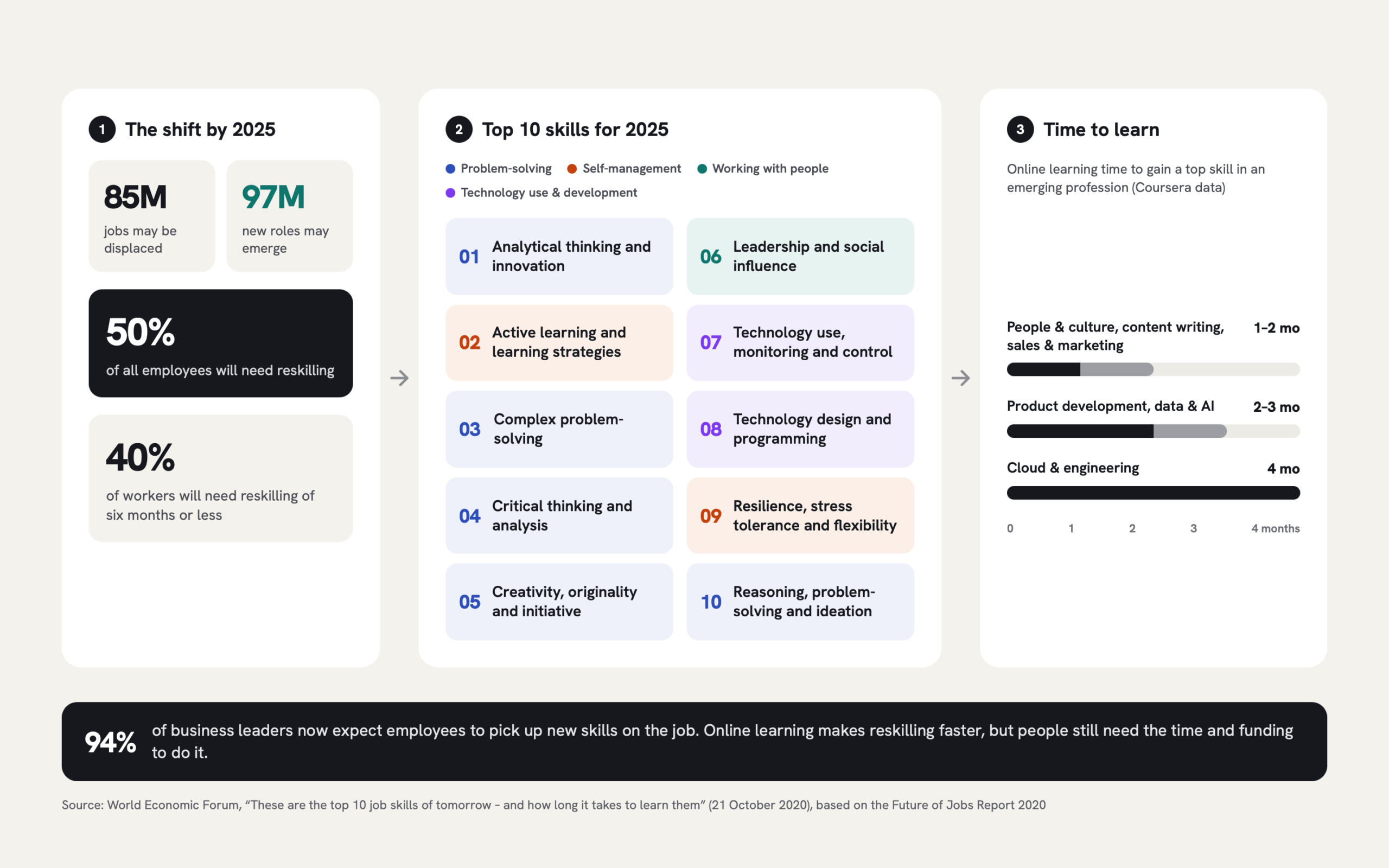
This consistency is worth pausing on. It suggests the demand for critical thinking in agencies isn’t a passing trend tied to one technology cycle. It’s a structural response to how quickly information, tools, and expectations change.
Agencies sit in an unusual position here. Clients often pay not just for execution but for judgement, and judgement is precisely what critical thinking protects. A team can defer entirely to whatever a template, a process document, or an AI system produces. But without pausing to check that output actually fits the situation, the agency stops adding the one thing a client can’t easily get elsewhere.
What this looks like in day-to-day agency work
Critical thinking rarely announces itself dramatically. It tends to show up as small, repeatable habits in how a team reaches a decision, not a single heroic moment of insight. In client-facing agency work, it tends to include the following.
- Asking why before how. Pause before execution to check that the underlying assumption behind a brief, a recommendation, or a plan is actually sound.
- Separating correlation from causation. Notice when two things happened together without immediately assuming one caused the other, especially when reporting results back to a client.
- Actively seeking disconfirming evidence. Look for the data point, the client, or the colleague’s opinion that challenges the current plan, rather than only gathering support for a conclusion already reached.
- Distinguishing a confident answer from a correct one. Fluency and confidence, whether from a person or an AI system, are not the same thing as accuracy.
- Applying the most scrutiny where a mistake would be most costly. Don’t spread the same shallow level of review evenly across every decision.
None of these habits are dramatic on their own. That’s exactly why they’re the first thing to slip when a team is moving fast.
AI and critical thinking: why the two now depend on each other
People often frame AI and critical thinking as opposites. Using one, the thinking goes, means giving up the other. The more accurate framing is that AI has made critical thinking a precondition for using the technology safely, not a nice-to-have alongside it.
Generative AI systems are remarkably good at producing fluent, confident-sounding output. That fluency is exactly what makes uncritical reliance on them risky. An AI system has no internal sense of when it has got something wrong. Catching that falls entirely to the human reviewing the output. When a team treats AI-generated material as a finished answer rather than a first draft worth interrogating, the habit of critical evaluation weakens from simple lack of use.
We’ve written before about how agencies use AI internally, covering quality, safeguards, and transparency. The underlying argument there is the same one this piece makes: those three things are critical thinking, applied systematically to AI output.
Avoiding cognitive bias in decision making
Avoiding cognitive bias in decision making is one of the more concrete, evidenced reasons critical thinking earns its place in agency work. Cognitive biases such as confirmation bias, anchoring, and overconfidence quietly distort judgement long before anyone notices. They affect experienced decision-makers just as much as inexperienced ones. That’s part of why they’re so persistent.
Research summarised by McKinsey on behavioural strategy found that organisations which actively work to reduce bias in major decisions tend to see meaningfully better outcomes. That work draws on behavioural economics research into the limits of rationality, and how systematically decision-makers deviate from purely rational calculations.
That evidence matters for agencies specifically. Many of the recommendations an agency makes carry real stakes, whether about a platform choice, a migration approach, or a content strategy. An unexamined bias can quietly steer a client toward the wrong outcome.
A few practical steps help counteract this. Assign someone in a review to deliberately challenge the prevailing view. Separate when a team makes a recommendation from when it needs to deliver it. Treat any option that arrived first or loudest with a little more scepticism.
The cost of skipping it
The cost of skipping critical thinking in agencies rarely announces itself at the point a team takes the shortcut. It tends to surface later, once the consequences have compounded into something harder to unpick.
A team mistakes a confident pitch for genuine substance, and a hiring or vendor decision goes ahead on that basis. A plan goes unchallenged in a meeting because no one wants to be the person who slows things down, even when several people privately have doubts. A team ships AI-generated material to a client without checking it against the underlying facts, because it read fluently. The same mistake keeps recurring across projects, simply because no one paused long enough after the first instance to ask why.
Individually, each of these looks like a minor lapse. Collectively, they tend to be the actual root cause behind the moments a team looks back on and asks how they missed something so avoidable.
Building the habit back into how teams operate
Critical thinking skills in the workplace are a practice, not a fixed personality trait. A person or a team can deliberately reintroduce them, even after they’ve slipped. A few concrete habits tend to make the most difference.
- Build in a pause before sign-off. Ask a single question, such as what would have to be true for this to be wrong. It costs very little time and catches a surprising number of avoidable errors.
- Assign a deliberate challenger. Rotate responsibility for pressure-testing a plan across a team. It normalises disagreement as routine, rather than personal.
- Treat AI output as a first draft, not a finished answer. Review AI-generated work the way an experienced editor reviews a junior colleague’s first pass. Keep the habit of scrutiny active, not dormant.
- Separate the decision from the deadline. Decouple when a team needs to decide from when the work needs to ship, wherever that’s possible. It reduces how many decisions get made under artificial time pressure.
- Keep an honest record of past mistakes. A simple, ongoing log, reviewed periodically rather than filed away, makes the case for slowing down concrete rather than theoretical.
How to evaluate a WordPress agency for critical thinking, not just capability
Anyone working out how to evaluate a WordPress agency tends to focus first on technical capability, delivery process, and security credentials. All three matter a great deal. But critical thinking in agencies is one of the clearest, most practical signals of whether a prospective partner will actually serve an organisation well, rather than simply agreeing with whatever brief lands on their desk.
A partner willing to push back on a flawed requirement is demonstrating exactly this. So is one who asks why before jumping straight to how, or says plainly that a proposed approach isn’t right. These are the habits this piece describes above, under real commercial pressure rather than in the abstract.
We’ve explored this in more depth in what to evaluate when choosing an agency, which sets out the four pillars we think matter most: technical capability, delivery maturity, security and governance, and strategic alignment. Critical thinking runs underneath all four. A partner can score well against every documented pillar and still fail to apply real judgement when a client’s situation doesn’t quite match the template.
Critical thinking in agencies isn’t a soft skill sitting alongside the real work. It’s the difference between a decision that happens to turn out well and one an organisation can actually rely on. The more useful question usually isn’t whether something looks right at first glance. It’s why you believe it actually is.
FAQ: Critical Thinking in Agencies
It’s the discipline of evaluating information, assumptions, and recommendations on their actual merits. It means not accepting them simply because they arrived confidently, quickly, or from an authoritative-sounding source.
Because AI and critical thinking now depend on each other, rather than sitting in opposition. Generative tools can genuinely widen the range of options a person considers. But that only holds if the human reviewing the output keeps questioning it.
Through small, repeatable habits practised consistently. Pause before sign-off. Actively seek out disconfirming evidence. Assign someone to challenge the prevailing plan. Treat both AI output and expert opinion as a starting point, not a settled conclusion.
Cognitive bias describes the specific, largely unconscious distortions, such as confirmation bias or anchoring, that quietly skew judgement. Critical thinking is the broader, deliberate practice that catches and corrects for those distortions.
Look for evidence that the agency questions a brief rather than simply executing it. Look for a team that asks why an approach is right for the specific situation, and one willing to disagree with a client when the evidence points elsewhere.