


For a long time, enterprise teams have been stuck with an uncomfortable trade-off. In 2026, WordPress breaks it.
You could scale fast, but only by accepting rigidity, brittle tooling, and a growing maintenance burden. Or you could stay flexible, at the cost of control, consistency, and long-term sustainability.
That false choice has shaped how digital platforms are designed, built, and governed for over a decade.
Until now, that is. WordPress is no longer just a publishing platform: it’s evolving into an intelligent CMS. One that combines structured data, reusable patterns, and increasingly agentic workflows to help teams move faster without creating fragility.
This shift changes what enterprise teams should prioritise, what they can safely stop over-engineering, and how they can build systems that adapt over time instead of fighting change.
Here’s how to get the most out of WordPress in 2026.
1. Stop chasing stacks
For years, enterprise digital platforms have grown by accumulation.
Another tool to manage content.
Another service to orchestrate workflows.
Another layer of glue code to hold it all together.
The result is complexity that slows teams down and makes change expensive.
Modern WordPress reduces that complexity by delivering more integrated capability out of the box. Core concepts like blocks, patterns, data relationships, and extensibility now work together as a system rather than isolated features.
Less glue code.
Fewer fragile integrations.
More momentum.
The opportunity for enterprise teams is to simplify their stacks, not expand them, and to treat WordPress as a platform that can carry more responsibility without the traditional complexity tax.
2. Design systems, not pages
One of the most important mindset shifts is moving away from page-by-page thinking.
Reusable blocks and synced patterns allow teams to design systems rather than individual experiences. You build once, then scale everywhere. Updates propagate safely. Consistency becomes an asset rather than a constraint.
For large organisations, this changes how design, development, and content teams collaborate. Governance no longer means locking things down. It means defining strong patterns and letting teams move quickly within them.
3. Structure first, visual always
Enterprise platforms often fail editors in one of two ways.
Either they prioritise structure and governance but make publishing slow and frustrating. Or they prioritise visual freedom but sacrifice consistency and data quality.
WordPress in 2026 makes it possible to have both.
Structured data sits underneath flexible, visual interfaces. Editors can move quickly without breaking rules they never see. Platforms remain robust without feeling heavy.
This balance is essential for teams producing content at scale, across markets, brands, and channels.
4. Think in capabilities, not features
Traditional platforms are built around features. Each new requirement leads to another custom build or plugin.
WordPress is increasingly built around capabilities.
Block bindings, composability, and shared data models allow teams to create systems that evolve. Future change becomes configuration and extension, not a rebuild.
When platforms are designed this way, adaptability becomes the default. Custom code becomes the exception rather than the foundation.
5. Let workflows do the work
Another major shift is the rise of agentic workflows.
Repetitive effort that once required manual intervention can increasingly be orchestrated. Content preparation, transformation, quality checks, and distribution become coordinated systems rather than individual tasks.
This allows teams to scale output without scaling headcount. It also reduces risk by removing human error from routine processes.
For enterprise organisations under constant pressure to do more with less, this isn’t a nice-to-have – it’s a competitive advantage.
6. Govern without slowing down
Control and speed no longer need to be opposites.
Centralised patterns combined with decentralised execution allow platforms to remain governed while enabling teams to act independently. Standards are enforced through design, not policy documents. Guardrails replace bottlenecks.
This is where WordPress is heading, and where many enterprise platforms need to go if they want to stay relevant.
7. Build for what comes next
The real power of WordPress in 2026 is what it enables tomorrow.
Platforms built around adaptability outperform those built around custom code every time. They absorb change rather than resist it. They evolve without constant reinvention.
Enterprise teams now face a clear choice.
Build on an intelligent CMS.
Or compete against teams who already are.
Go deeper: WordPress in 2026
This post only scratches the surface of what’s changing and why it matters.
Our new report, WordPress in 2026: The dawn of the intelligent CMS, explores what this shift means for enterprise teams, platforms, and the next decade of digital experiences. It covers what to prioritise, what to stop over-engineering, and how to design systems that remain resilient as WordPress continues to evolve.
We are also hosting WP:26, a dedicated event where we will unpack the themes from the report, share real-world examples, and explore what intelligent CMS architecture looks like in practice.
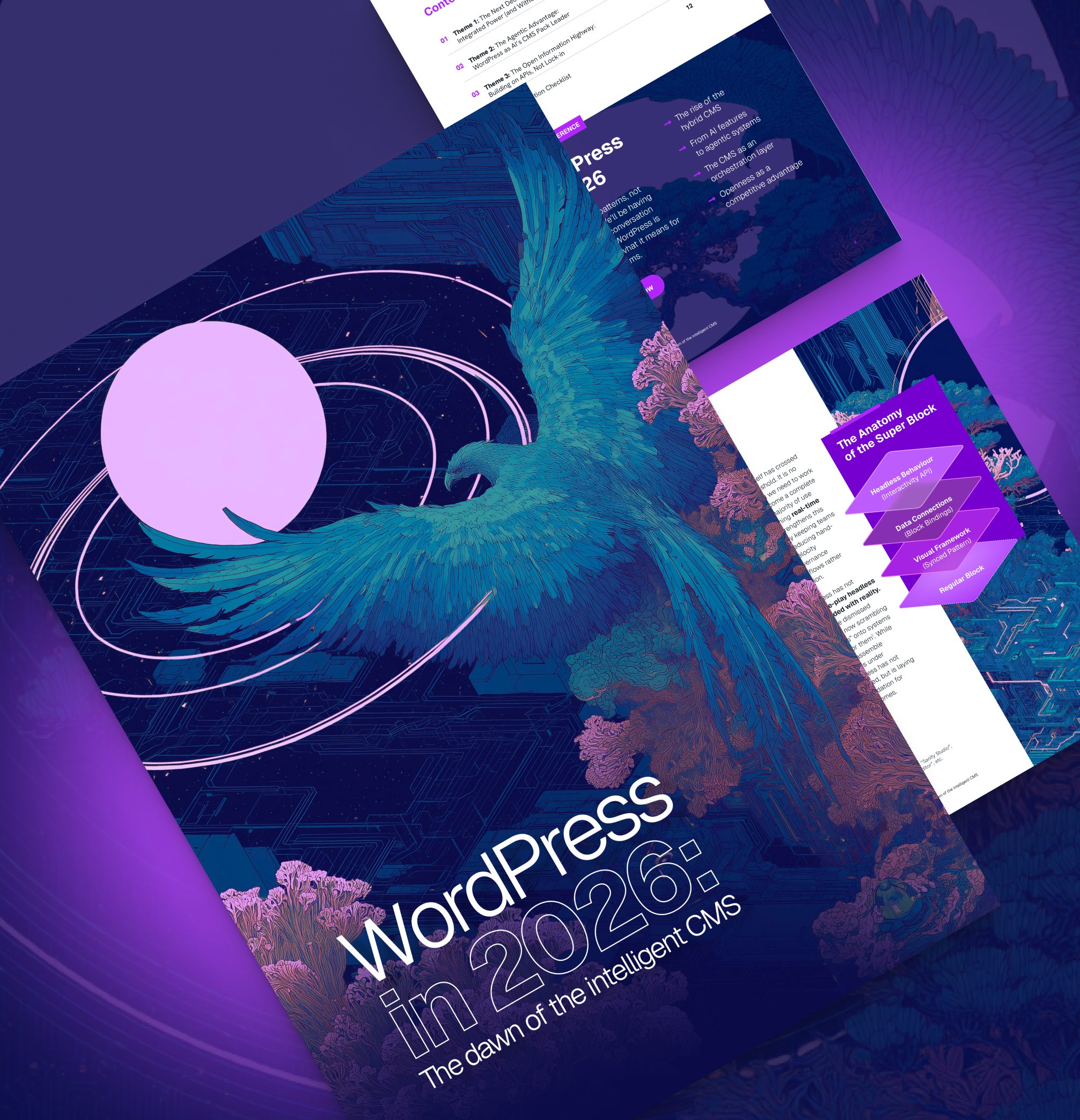
👉 Download the report: WordPress in 2026: The dawn of the intelligent CMS
👉 Register for WP:26 to join the conversation and go deeper on what comes next
If you’re responsible for the future of a WordPress platform at scale, now is the moment to rethink what your CMS can be.