



AI is already part of how enterprise teams work. Quietly in some places, more visibly in others.
Editors use it to summarise long-form content. Marketers lean on it for campaign copy and optimisation. Content teams use it to analyse performance and spot gaps. What started as experimentation has moved into daily workflow faster than most platforms have been able to keep up with.
That gap is where things start to get messy.
Where things start to break down
In many organisations, AI still sits outside the core publishing environment.
An editor drafts in the CMS, switches to an AI tool to generate a summary, copies it back, tweaks it, then repeats the process for metadata, headlines, or social variations. Multiply that across teams, regions, and content types, and it quickly becomes fragmented.
It works, up to a point. Then it doesn’t.
Outputs vary in quality. Content loses structure. There’s no consistent way to apply standards or track how AI is being used. What feels like a productivity boost at the individual level starts to create friction at scale.
The platform, instead of supporting the workflow, sits slightly to one side of it.
Bringing AI into the editorial experience
The real shift happens when AI moves into the platform itself.
Inside WordPress, AI can become part of the editorial flow rather than something separate. Editors can generate summaries, refine copy, suggest metadata, or enrich content without leaving the interface they already know.
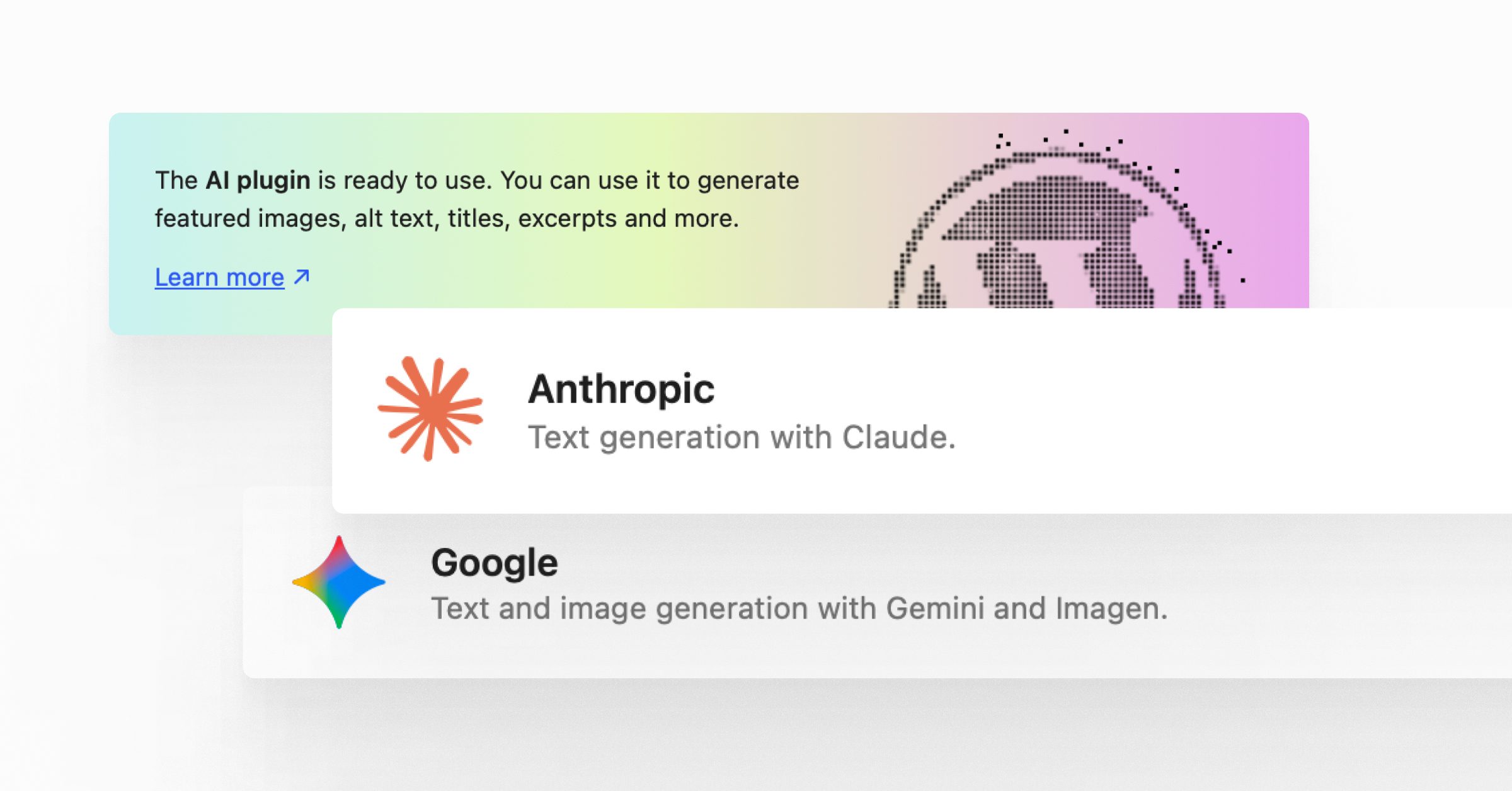
That alone reduces friction. But the bigger impact comes from what happens behind the scenes.
Because the content stays structured, those AI-generated elements are more than text pasted into a field; they’re part of a system that can be reused, queried, and adapted across channels. A summary becomes an input for search. Metadata feeds personalisation. Structured content opens up new distribution paths.
Small changes in workflow start to compound.
From isolated tasks to connected workflows
Most early AI adoption focuses on speeding up individual tasks.
Write this faster. Summarise that quicker. Generate a few variations.
Useful, but limited.
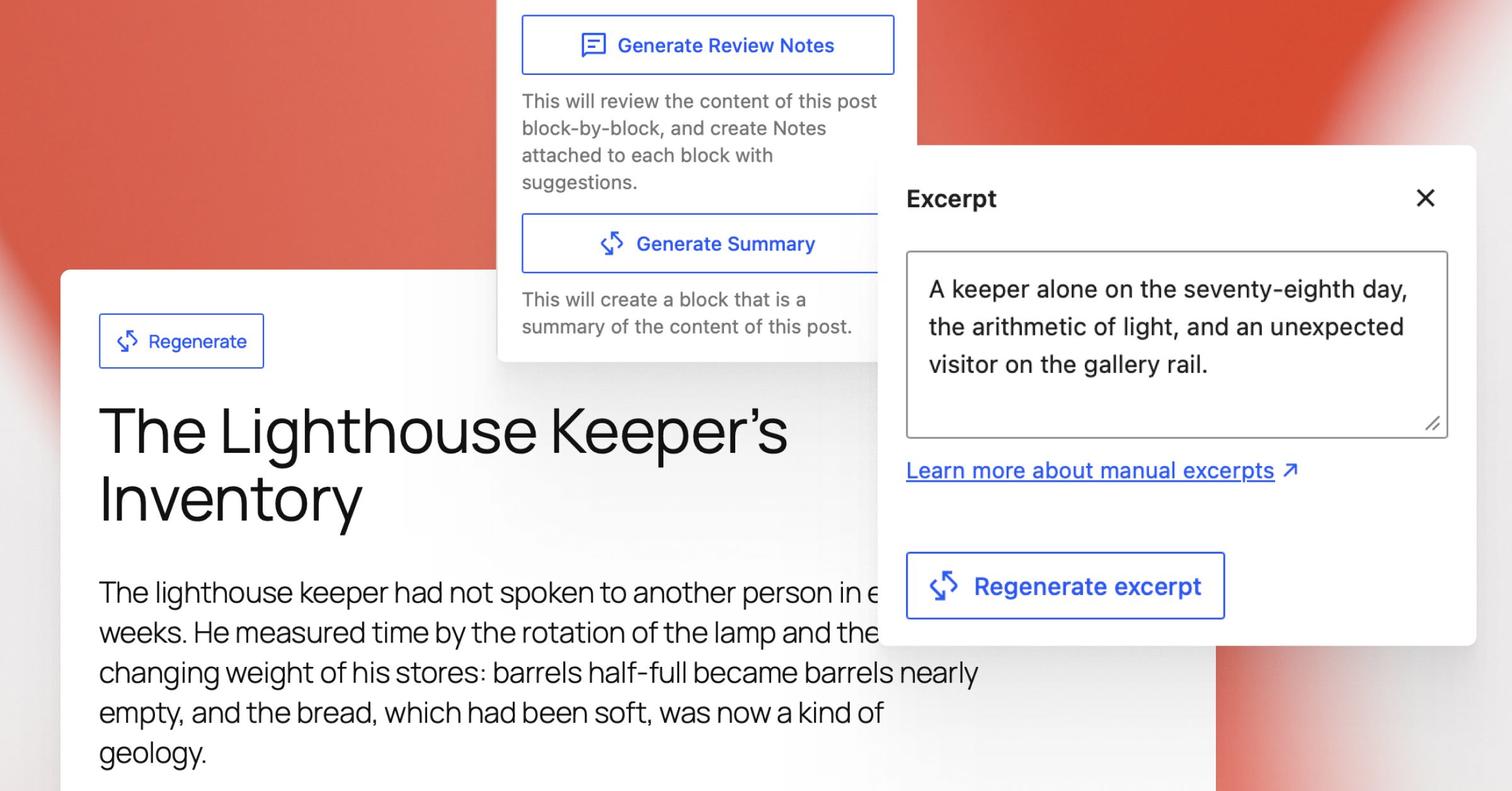
The bigger opportunity sits in connecting those tasks together into workflows that build on each other. Analysing a content archive to surface high-value material. Extracting entities and applying consistent taxonomy. Feeding that structure back into new content creation.
Over time, the platform becomes smarter about the content it holds.
Teams spend less time repeating the same work and more time shaping outputs. Editorial effort shifts from production to refinement. Consistency improves without adding overhead.
That is where scale starts to show.
Making governance part of the system
As AI becomes more embedded, the conversation quickly moves beyond productivity.
Accuracy matters. Bias matters. Brand voice matters. At enterprise scale, those concerns cannot be handled informally or left to individual judgement.
They need to be designed into the system.
WordPress gives teams the ability to do that. Review steps can be built into workflows. Permissions can define who can generate, edit, and publish AI-assisted content. Prompts can be managed centrally. Outputs can be tracked and audited.
Nothing sits in a black box.
This creates a different dynamic. Teams can move quickly, experiment with new use cases, and still maintain control over what goes live. Governance becomes part of the workflow, not something layered on afterwards.
Why flexibility matters more than ever
AI capabilities are evolving at pace.
New models, new providers, new use cases. What works today might not be the right fit in six months. Locking into a single approach too early can limit what teams are able to do later.
This is where platform flexibility becomes critical.
With WordPress, AI integrations can be adapted over time. Different services can be connected through a consistent interface. Workflows can evolve as teams learn what delivers value. There is room to experiment without committing to a fixed path.
That ability to adjust matters just as much as the initial implementation.
It also points to where things are heading. WordPress is beginning to move beyond simple integrations towards a more agent-driven model, where AI can take on more active roles within workflows. If you want a deeper look at that direction, this piece on WordPress as an agentic platform explores what that could mean in practice.
Publishing is becoming more dynamic
Content no longer moves in a straight line from draft to publish.
It is analysed, enriched, updated, and redistributed across multiple touchpoints. A single piece might feed a website, an app, a newsletter, a recommendation engine, and a search experience. AI helps drive that process, but only when it is connected to where the content actually lives.

Otherwise, it becomes another disconnected layer.
Platforms that support this kind of dynamic publishing tend to share a common trait. They treat content as structured data, not just formatted text. That structure is what allows AI to add value beyond surface-level generation.
It is what makes content reusable, adaptable, and easier to govern.
Closing the gap between capability and execution
AI adoption is accelerating, regardless of whether platforms are ready.
Teams will continue to use it where they can. The risk is not adoption itself, but inconsistency. Different tools, different standards, different outputs. Over time, that becomes harder to manage and harder to scale.
Bringing AI into the core platform closes that gap.
For enterprise teams working with WordPress, that shift is already underway. The platform’s extensibility makes it possible to integrate AI in ways that reflect real workflows, not idealised ones. It allows teams to move faster while keeping structure, visibility, and control.
That balance is what turns AI from a useful tool into a meaningful capability.
And it is what will define how publishing continues to evolve.