



For years, the enterprise CMS conversation has treated lock in as a feature.
Proprietary platforms promise stability by owning the stack end to end. Integrations are gated. Extensibility comes at a premium. Exit paths quietly disappear over time. The assumption is simple. If leaving is hard enough, customers will stay.
But in an increasingly complex digital environment, that logic is breaking down.
As organisations scale across channels, products, and regions, trust is no longer earned by control. It is earned by openness. By clean integration. By the confidence that your data, your schemas, and your systems are not trapped.
This is where WordPress in 2026 quietly but decisively changes the conversation.
A pragmatic post-suite platform
WordPress fully embraces the post-suite world of JAMStack and MACH, but without the ideological rigidity that often comes with it.
Rather than attempting to own everything, WordPress focuses on integrating cleanly. Rather than charging extra for “integrators” or proprietary add ons, it doubles down on open APIs and predictable interfaces. The result is a platform and enterprise-grade CMS that can be shaped around almost any business case, instead of forcing the business to contort around the platform.
This pragmatism matters. In chaotic digital ecosystems, the most valuable tools are not the most ambitious ones. They are the ones that fit.
From CMS to universal content layer
At the heart of this shift is data liberation.
The Data Liberation project has evolved well beyond one way exports. In 2026, WordPress supports bi directional synchronisation, allowing it to act as a central content warehouse. Content flows out to satellite sites, mobile applications, and internal tools. Where appropriate, it can flow back in.
Combined with the REST API, this positions WordPress as a universal content layer. A system that connects rather than encloses. A foundation that supports growth without dictating architecture.

Your data is not trapped.

Your schemas are not proprietary.

Exit remains possible at all times.
And that’s why it’s the CMS of choice for so many enterprise organisations.
Why exit builds trust
There is a paradox at the centre of open platforms.
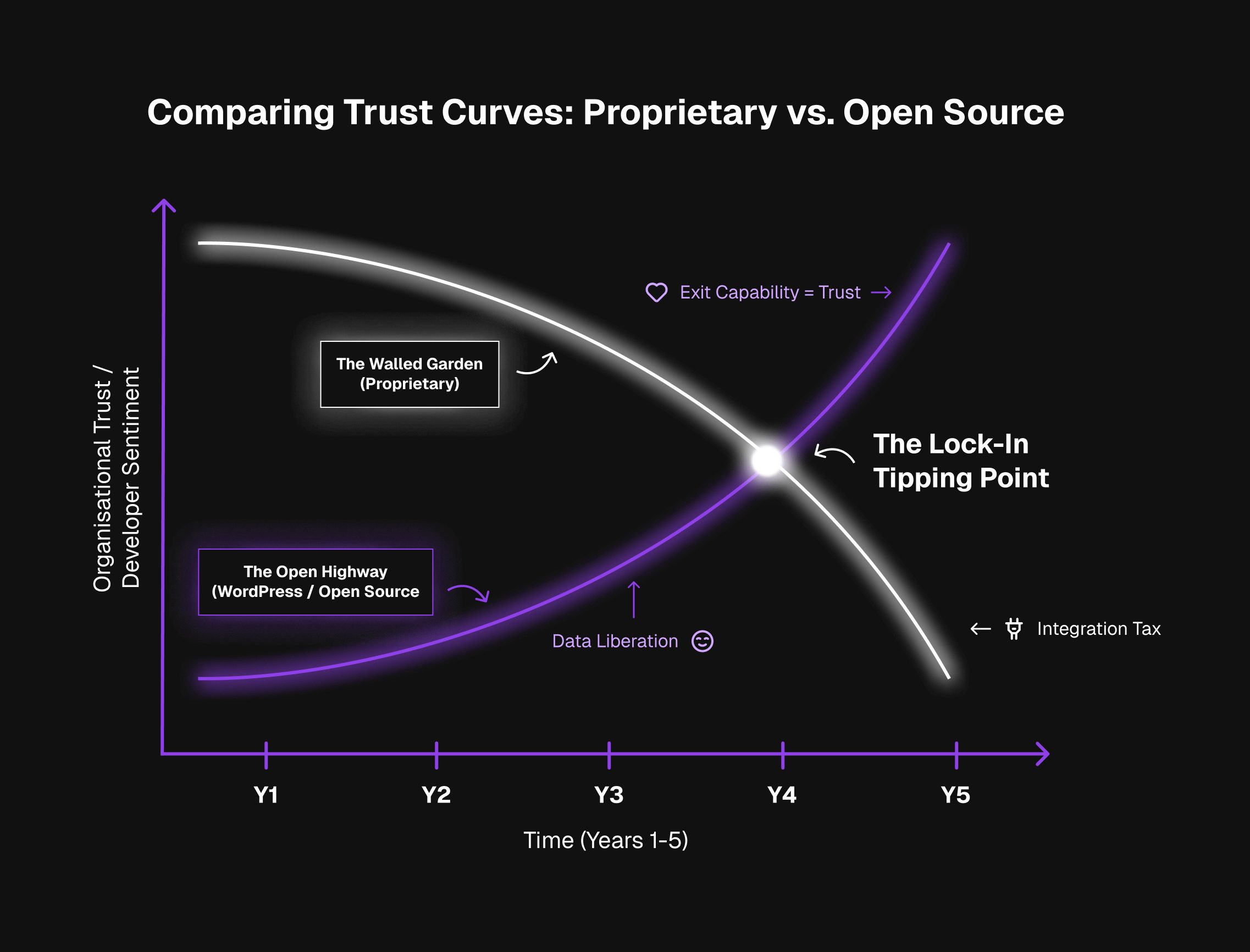
When switching costs are lowered by design, organisations feel safer committing long term. When exit is possible, trust increases. And when trust increases, it compounds over time.
This is what we see repeatedly in open source ecosystems. Early on, proprietary platforms often feel faster. Over time, integration tax accumulates, flexibility erodes, and confidence drops. Open systems move more slowly at first, then accelerate as trust, tooling, and community compound.
WordPress is now firmly on the upward curve of that trajectory.
The real advantage of WordPress in 2026
The most important shift is not any single feature. It is the philosophy that connects them.
WordPress in 2026 is not trying to be everything. It is becoming the connective tissue that lets everything else work together. A platform designed for adaptability, not dependence.
In the years ahead, the organisations that win will not be the ones that locked themselves into the deepest stack. They will be the ones that built systems they could change.
WordPress is making that future easier to choose.
Go deeper
This post only scratches the surface.
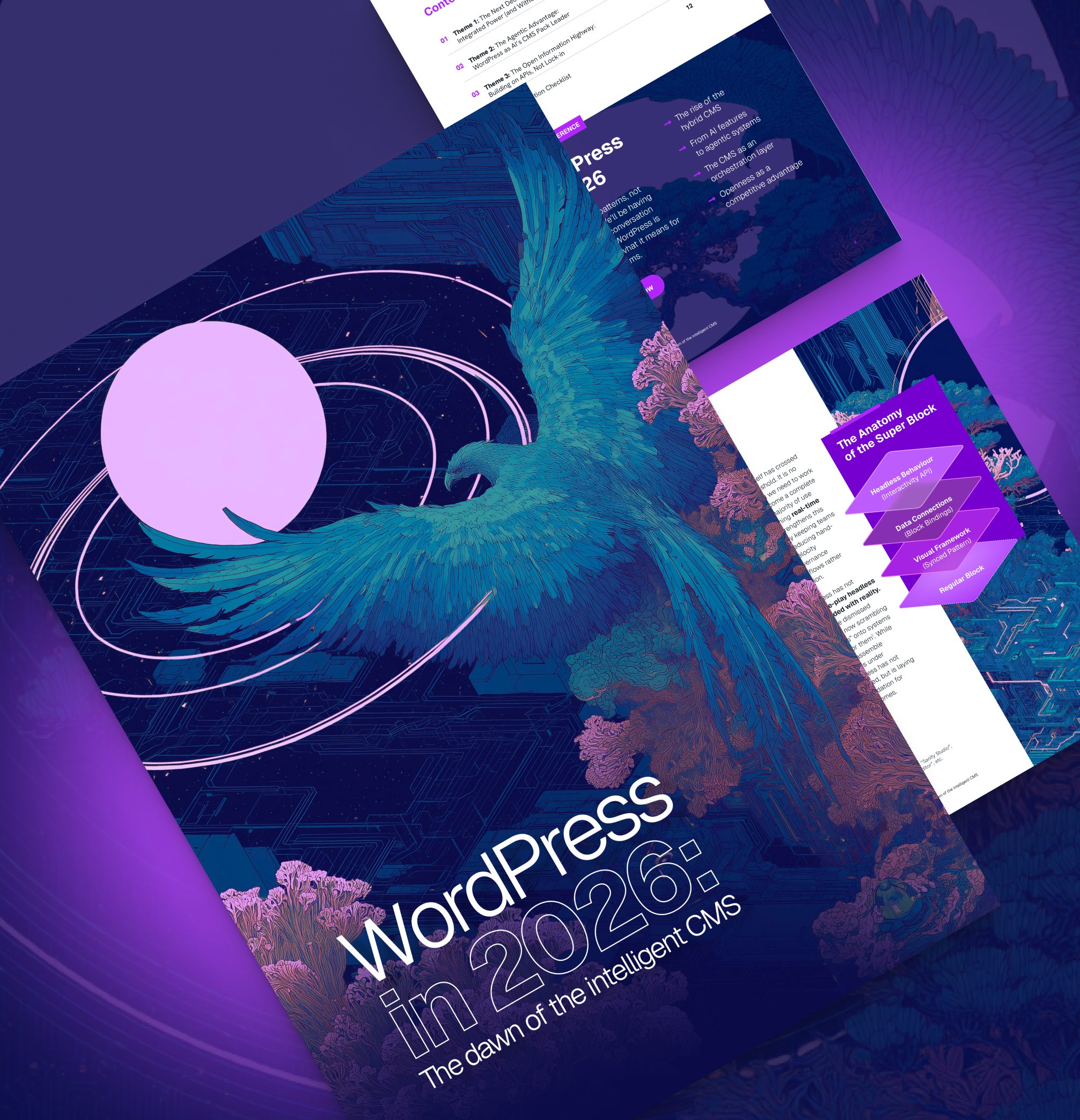
To explore the full thinking behind WordPress’s evolution, download our latest market analysis, WordPress in 2026: The dawn of the intelligent CMS.
And if you want to dig into these ideas with industry peers, join us at WP:26, our upcoming event exploring what this shift means for platforms, teams, and the next decade of digital experiences.
The future is already arriving. The question is how deliberately you build for it.